

What Does a Boiler Inspection Consist Of?
- PVI
- Jul 25
- 6 min read
A boiler can appear to be operating normally while corrosion, fatigue, overheating or a deteriorating safety device develops out of sight. For operators, the practical question is: what does a boiler inspection consist of when the objective is to establish safe condition, meet obligations under AS 3788 and maintain a defensible compliance record? It is a structured assessment of the boiler, its protective devices, its operating history and the evidence supporting its continued service.
The exact scope depends on the boiler type, design registration, operating pressure and temperature, age, duty cycle, water treatment regime, previous findings and applicable jurisdictional requirements. A low-pressure heating boiler does not present the same inspection considerations as a high-pressure steam boiler supporting continuous production. In each case, the inspection must be planned around the equipment's service conditions and credible damage mechanisms.
The purpose of an in-service boiler inspection
An in-service inspection is not simply a visual check or a certificate renewal exercise. Its purpose is to determine whether the pressure equipment remains fit for continued operation, identify deterioration before it compromises containment or safety, and specify any action required to maintain compliance.
For Australian plant owners, AS 3788 provides the central framework for in-service inspection of pressure equipment. It addresses inspection intervals, inspection methods, documentation and the competency of personnel undertaking the work. The standard must be applied alongside the relevant work health and safety legislation, the boiler's original design and operating documentation, and the site's risk controls.
A competent independent inspector assesses condition objectively. This distinction matters where inspection findings may affect maintenance priorities, shutdown scope or decisions about repair and continued operation. Recommendations should be based on evidence, applicable standards and engineering judgement, not on an interest in carrying out repair work.
What does a boiler inspection consist of under AS 3788?
A boiler inspection commonly combines a document review, external examination, internal examination where access is available and appropriate, assessment of safety devices, and a review of any non-destructive testing or thickness data required to establish condition. The result is an inspection report that records observations, findings, required actions and the basis for certification or continued service.
Review of records and service history
The inspection begins before the inspector enters the boiler house. Records provide the context needed to target the examination and assess whether the equipment has been managed in accordance with its inspection plan.
Relevant information commonly includes the boiler data plate details, design registration, previous inspection reports, certificates, repairs and alterations, operating logs, water treatment records, safety valve test records, control and interlock test results, and any history of leaks, tube failures, low-water events or abnormal operating conditions.
This review can reveal recurring concerns that are not obvious during a single site visit. For example, repeated poor water chemistry results may increase the likelihood of scale formation, oxygen pitting or under-deposit corrosion. A history of nuisance safety-valve lifting may point to operating control issues, incorrect valve selection or pressure excursions requiring further assessment.
External examination of the boiler and installation
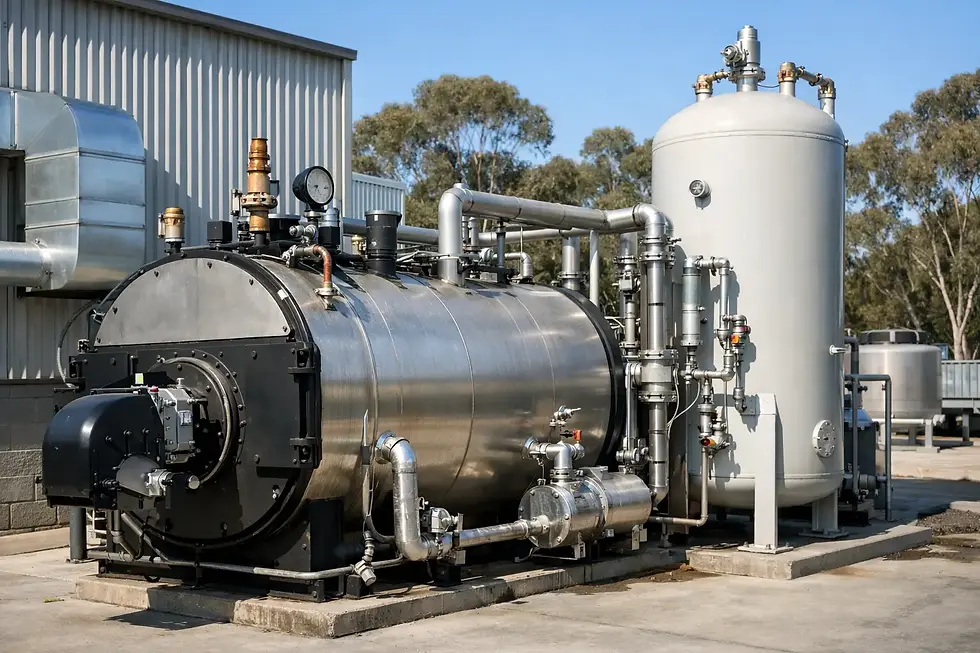
An external inspection assesses accessible pressure parts and the wider installation. The inspector examines the boiler shell, furnace, headers, tubes, pipework connections, valves, supports, insulation condition where relevant, and evidence of leakage, corrosion, mechanical damage or distortion.
Attention is also given to the environment around the boiler. Water leaks, inadequate drainage, corrosive atmospheres, poor access, damaged lagging and unprotected external surfaces can accelerate deterioration or make routine maintenance less reliable. For packaged boilers, the examination may extend to burner arrangements, fuel train interfaces, controls and combustion-related safeguards, while recognising that specialist burner testing may sit within a separate maintenance scope.
The condition of mountings and protective devices is critical. Safety valves, pressure gauges, water level indicators, low-water protection, feedwater arrangements and isolation valves must be suitable for the boiler's duty and maintained in a condition that supports their intended function. An inspection does not replace functional testing by qualified service personnel, but it should verify that required testing and maintenance evidence is available and that the installed arrangement appears appropriate.
Internal examination of pressure parts
Where a boiler is opened and safely prepared for inspection, an internal examination allows direct assessment of areas that cannot be judged from the outside. This may include the steam and water spaces, furnace, tube plates, stays, seams, headers, mud drums, tube ends and accessible internal surfaces.
Preparation is essential. The boiler must be isolated, depressurised, drained, cooled, cleaned as necessary and made safe for access. Where confined-space entry is required, the asset owner must manage the applicable entry controls, permits and atmosphere testing.
Internal inspection looks for corrosion, pitting, scale, sludge, erosion, cracking, grooving, bulging, distortion, overheating and evidence of previous repair. The significance of a finding depends on its location, extent and underlying cause. Light surface corrosion in a non-critical accessible area may warrant monitoring. Localised pitting at a pressure boundary, cracking near a highly stressed connection or tube damage associated with a low-water event may require immediate engineering assessment.
Not every boiler can or should be opened at every inspection. Inspection intervals and scope should reflect AS 3788 requirements, service history, condition trends, access constraints and risk. A condition-based approach can be appropriate where it is supported by adequate evidence, inspection planning and competent engineering judgement.
Thickness measurement and non-destructive testing
Visual examination alone cannot confirm the remaining wall thickness of all pressure parts. Where corrosion, erosion or service conditions indicate a credible risk of material loss, ultrasonic thickness testing may be used to measure the remaining thickness of shells, drums, pipework and other accessible components.
Measurements are most useful when they are taken at defined locations and compared over time. A single reading provides a snapshot. A consistent series of readings can establish corrosion rate, identify localised deterioration and support remaining-life decisions.
Additional non-destructive testing may be required when cracking, weld defects or other discontinuities are suspected. The method selected should suit the material, component geometry and expected damage mechanism. Magnetic particle, dye penetrant, ultrasonic or radiographic examination may be considered, but the need for testing should be determined by the inspection findings and engineering assessment rather than applied as a routine exercise without purpose.
Safety devices, controls and associated equipment
A boiler inspection considers whether essential protective equipment is present, identifiable and supported by maintenance and test records. This commonly includes safety valves, pressure indicators, water level devices, low-water cut-outs, pressure controls, alarms and interlocks.
The inspector will review whether safety valves have been tested, set and sealed as required, whether gauges are readable and suitable for the operating range, and whether low-water protection is being maintained and tested. The inspection may also consider feedwater system condition, blowdown arrangements, stop valves and the interfaces between the boiler and connected pressure piping.
There is an important boundary here. Certification inspection, electrical testing, burner commissioning and mechanical maintenance are related activities, but they are not interchangeable. A boiler may have been serviced recently and still require an independent in-service inspection to assess pressure integrity and compliance. Conversely, an inspection finding may identify the need for specialist maintenance or repair before certification can be finalised.
Assessment, reporting and certification
The final stage is the technical assessment of the evidence gathered. The inspector considers the boiler's observed condition, previous findings, testing results, operating history and compliance documentation. Where defects are identified, the report should clearly distinguish between matters requiring immediate action, work required before return to service, and items that may be managed through monitoring or planned maintenance.
A useful report identifies the equipment unambiguously, describes the inspection scope and limitations, records defects with sufficient detail for action, and states the basis for any recommendation or certification outcome. Photographs, thickness readings, test certificates and repair documentation may form part of the inspection record.
If repair or alteration is required, it should be controlled through an appropriate process. The scope, welding procedures, personnel qualifications, examination requirements and post-repair inspection must be appropriate to the equipment and the work undertaken. For boilers with international design or repair contexts, ASME and National Board requirements may also be relevant.
For asset owners, the value of this process lies in more than satisfying a scheduled obligation. Clear inspection records support maintenance planning, demonstrate due diligence, provide a basis for managing residual risk and reduce the likelihood that an avoidable condition becomes an unplanned outage.
Preparing for a boiler inspection
The quality of the inspection is affected by the quality of preparation. Provide the inspector with current records in advance, ensure safe access to relevant areas, and plan shutdown, isolation and cleaning work early where an internal examination is due. Delays often arise not from the inspection itself, but from incomplete boiler preparation, unavailable documents or unresolved previous recommendations.
Pressure Vessel Inspections Pty Ltd applies independent, AICIP-accredited in-service inspection capability and an ISO 9001:2015 quality system to help South Australian asset owners assess boiler condition with technical discipline. The appropriate inspection scope should always reflect the specific boiler, its operating duty and the evidence available.
A well-planned inspection gives maintenance and operational teams something practical: a clear view of the boiler's condition, the actions that genuinely require attention, and the records needed to support safe continued operation.
Comments