
How Often Do Boilers Need to Be Inspected?
- PVI
- Jul 26
- 5 min read
A boiler can operate reliably for years, then develop a condition that is not visible during normal production. Corrosion beneath insulation, fatigue at welded connections, scale accumulation, burner-related overheating and safety-valve deterioration may progress without an obvious change in day-to-day performance. That is why the question, how often do boilers need to be inspected, cannot be answered safely with a single calendar date.
For Australian duty holders, boiler inspection frequency must be established against the equipment’s hazard level, service conditions, inspection history and the applicable regulatory framework. AS 3788, Pressure equipment - In-service inspection, provides the principal technical framework for determining and managing in-service inspection requirements for boilers and associated pressure equipment.
Boiler inspection frequency under AS 3788
AS 3788 requires a planned in-service inspection regime rather than a reactive maintenance approach. The appropriate interval depends on the boiler classification, its assigned hazard level, operating duty, previous inspection findings and whether deterioration mechanisms are present or reasonably foreseeable.
In practical terms, boiler owners should expect periodic external inspections while the boiler is operating, together with more detailed inspections undertaken during planned shutdowns. Internal examinations are normally required when the boiler is opened and made safe for inspection. The interval between these activities must not simply be adopted from a previous owner’s maintenance schedule or a generic rule of thumb.
The inspection plan should identify the equipment item, design and operating limits, hazard level, inspection type, due dates, responsible persons and the basis for the nominated interval. It should also record any conditions that require a shortened interval, additional monitoring or engineering assessment.
For many operating sites, an annual review of boiler condition, certification status and upcoming inspection obligations is a sound control measure. This does not mean every boiler has identical annual internal inspection requirements. It means the inspection program should be actively reviewed at least annually and adjusted where operating conditions or equipment condition warrant it.
Why a fixed interval is not always enough
Two boilers of the same age and design can require different inspection attention. A boiler operating in clean, stable service with well-controlled feedwater chemistry does not face the same deterioration risks as one subject to frequent cycling, poor water treatment, wet fuel, corrosive surroundings or extended periods of lay-up.
Inspection intervals may need to be reconsidered where there has been a change in operating pressure or temperature, a significant repair or alteration, repeated safety-valve lifting, evidence of water carryover, abnormal consumption of treatment chemicals, an excursion beyond design conditions or a history of tube leaks. A change in ownership or a gap in inspection records also warrants early technical review.
Condition-based planning can be appropriate where supported by adequate evidence, competent inspection and engineering judgement. It is not a reason to defer required examinations because the boiler appears to be operating normally. Reliable condition-based decisions depend on documented inspection results, known damage mechanisms and clear acceptance criteria.
External and internal boiler inspections serve different purposes
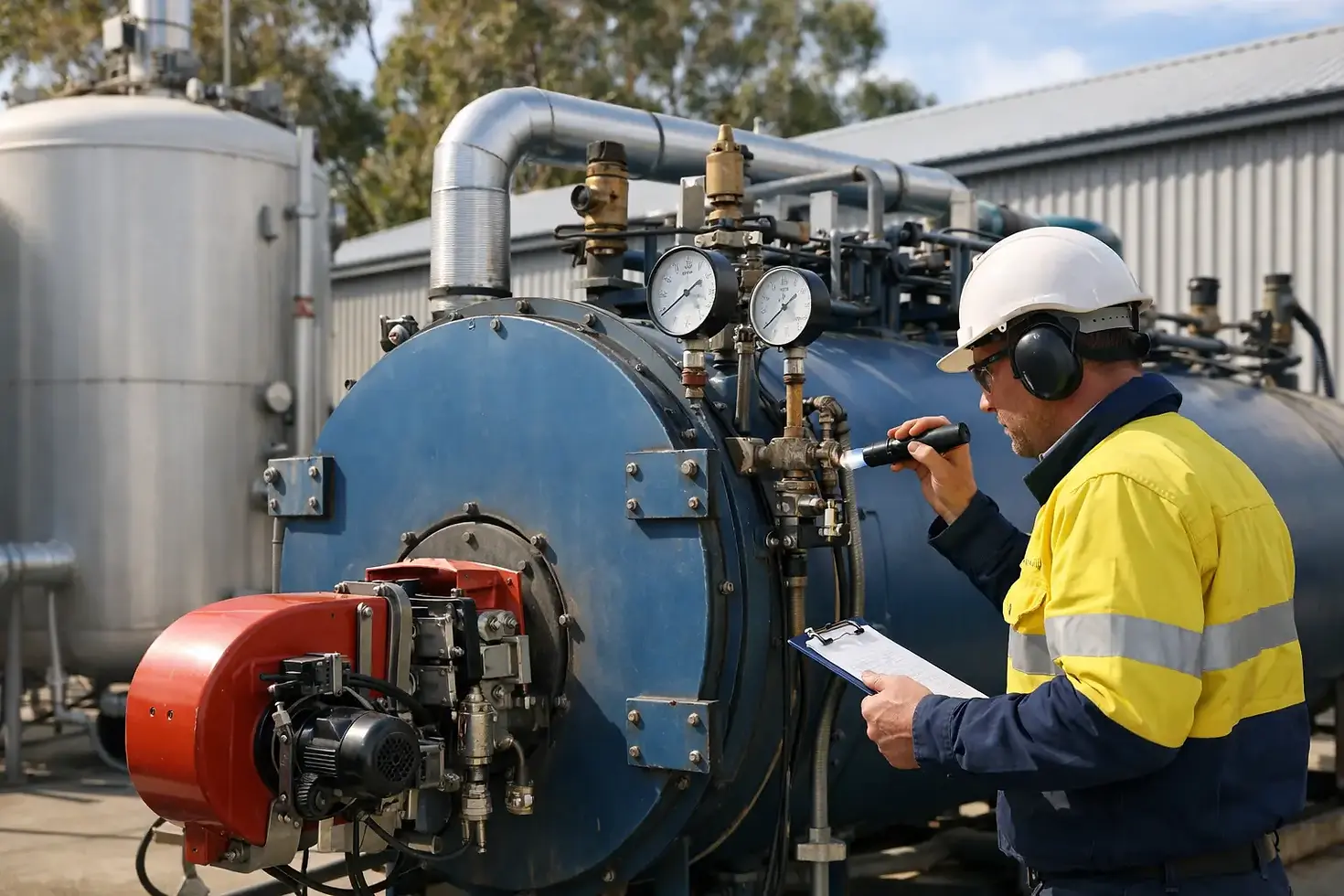
An external inspection assesses accessible pressure parts, mountings, controls, safety devices, pipework connections and the general operating condition of the boiler. It may include review of leaks, corrosion, insulation condition, signs of overheating, vibration, supports, nameplate data and the adequacy of records.
An internal inspection, conducted after isolation, depressurisation, cooling and appropriate preparation, allows the inspector to examine water-side and fire-side surfaces that cannot be assessed adequately in service. The scope may include drums, headers, tubes, furnaces, refractory, stays, welds, manholes and other internal components relevant to the boiler design.
The value of internal inspection is not limited to finding existing defects. It confirms whether operating controls are effectively limiting deterioration. For example, deposits and localised corrosion can indicate feedwater-treatment issues before they develop into tube failure, loss of containment or an unplanned shutdown.
Where access is restricted or a component cannot be examined directly, the inspection plan may require supplementary non-destructive examination, thickness measurement or an engineering assessment. The method must be selected for the expected degradation mechanism, not merely because it is convenient.
Events that should trigger an earlier inspection
A scheduled inspection date is not a licence to continue operating after a significant abnormal event. The duty holder should obtain competent advice following an incident that could affect pressure-boundary integrity or the safe operation of the boiler.
Examples include overheating, low-water incidents, furnace implosions, uncontrolled pressure excursions, suspected overpressure, major leakage, fire exposure, impact damage, prolonged wet lay-up or a repair to a pressure-retaining component. Boiler safety devices that have lifted repeatedly, failed to operate correctly or been removed for service should also be assessed within the broader inspection and certification process.
An earlier inspection may be limited to a targeted examination, or it may require the boiler to be taken out of service for a more comprehensive assessment. The correct response depends on the event, the boiler design, available operating data and evidence of damage. Independent advice is particularly valuable where production pressures may otherwise influence the decision to return equipment to service.
Records are part of compliance, not an administrative afterthought
A defensible inspection program is built on complete records. The boiler file should contain design and registration information where applicable, previous inspection reports, certificates, repair documentation, thickness readings, safety-valve test records, water-treatment data, operating history and details of any incidents or abnormal conditions.
These records allow the In-Service Inspector to identify trends. A single thickness reading may be acceptable, but a sequence of readings can reveal a corrosion rate that changes the remaining service assessment. Likewise, recurring repairs or repeated findings in one location may point to an underlying operating or design issue that needs engineering review.
Records also support continuity when maintenance personnel, operators or site management change. If an organisation cannot demonstrate what was inspected, what was found, what corrective action was taken and when the next examination is due, it cannot rely on assumptions about compliance or equipment condition.
Who should determine the inspection interval?
Inspection intervals and certification decisions should be determined by a competent, independent in-service inspection provider with the appropriate knowledge of AS 3788 and the boiler type involved. For regulated pressure equipment, competence is not simply familiarity with mechanical maintenance. It requires an understanding of pressure-equipment design, deterioration mechanisms, inspection methods, regulatory obligations and acceptance criteria.
AICIP accreditation is a recognised indicator of competence for pressure equipment inspection in Australia. For complex equipment, unusual service conditions, repairs, life-extension decisions or international design codes, additional expertise in ASME and National Board requirements may also be relevant.
Pressure Vessel Inspections Pty Ltd provides independent inspection and engineering advice without manufacturer, repairer or asset-owner bias. Its inspection personnel meet prescribed AS 3788 requirements for In-Service Inspectors, with AICIP-accredited capability supported by an ISO 9001:2015 quality system.
How to manage your next boiler inspection
The most reliable approach is to review the inspection status before the next shutdown is committed. Confirm the boiler’s current hazard level, identify the last external and internal inspection dates, check whether all recommendations have been closed out and assess whether operating conditions have changed since the previous examination.
Planned shutdown inspections should be scoped early enough to allow for cleaning, access, isolation, non-destructive examination and possible repair decisions. Leaving the scope until the boiler is opened can extend downtime and create avoidable pressure to accept incomplete inspection coverage.
A boiler inspection program should protect people first, while also providing management with a clear basis for continued operation. When the interval is set from AS 3788 requirements, actual equipment condition and independent technical judgement, inspection becomes a controlled part of asset management rather than a disruption discovered too late.
Comments