

How Long Does It Take to Get a Boiler Certification?
- PVI
- Aug 1
- 5 min read
A boiler cannot return to dependable service on the strength of a quick site visit alone. When asset owners ask, "how long does it take to get a boiler certification", the practical answer depends on the boiler’s condition, its inspection history, the quality of available records and whether the inspection can be completed during a planned outage.
For an operating boiler, certification is generally an in-service inspection and assessment process. It is not the same as obtaining a boiler operator qualification, registering new plant or commissioning newly manufactured equipment. The outcome must be supported by a suitable inspection scope, competent assessment and records that demonstrate the boiler can continue operating within defined limits.
How Long Does It Take to Get a Boiler Certification?
For a well-maintained boiler with current documentation and a planned shutdown, the on-site inspection may be completed within a day or over several days, depending on size, design and access requirements. The full certification process commonly takes longer because records must be reviewed, findings assessed, any recommendations addressed and a formal report prepared.
A straightforward planned inspection may progress from site inspection to completed documentation within one to two weeks. That timeframe is realistic only where the boiler has been properly prepared, no significant defects are identified and the inspector receives the necessary history promptly.
Where inspection identifies corrosion, cracking, damaged safety valves, tube degradation, leakage, inadequate controls or missing documentation, the programme can extend from weeks to months. The delay is not caused by certification administration. It is the time required to define the condition, complete appropriate repairs, verify the work and determine whether further inspection or testing is necessary before continued service can be supported.
For facilities with continuous production demands, the most effective way to control timing is to start the planning process well before the required outage. A certificate cannot responsibly be issued before the required inspection activities and technical review are complete.
What the Certification Process Involves
In-service boiler inspection should be planned with reference to AS 3788, applicable work health and safety obligations, the equipment’s service history and the operating environment. The scope is not identical for every boiler. A low-duty unit with a documented maintenance history presents a different inspection task from a heavily cycled process boiler operating in a corrosive or high-contaminant environment.
The process normally begins with a document review. This establishes the equipment identity, design and operating parameters, previous inspection reports, repair history, safety valve records, water treatment information and outstanding recommendations. Incomplete records do not automatically make certification impossible, but they can require further investigation and increase both cost and elapsed time.
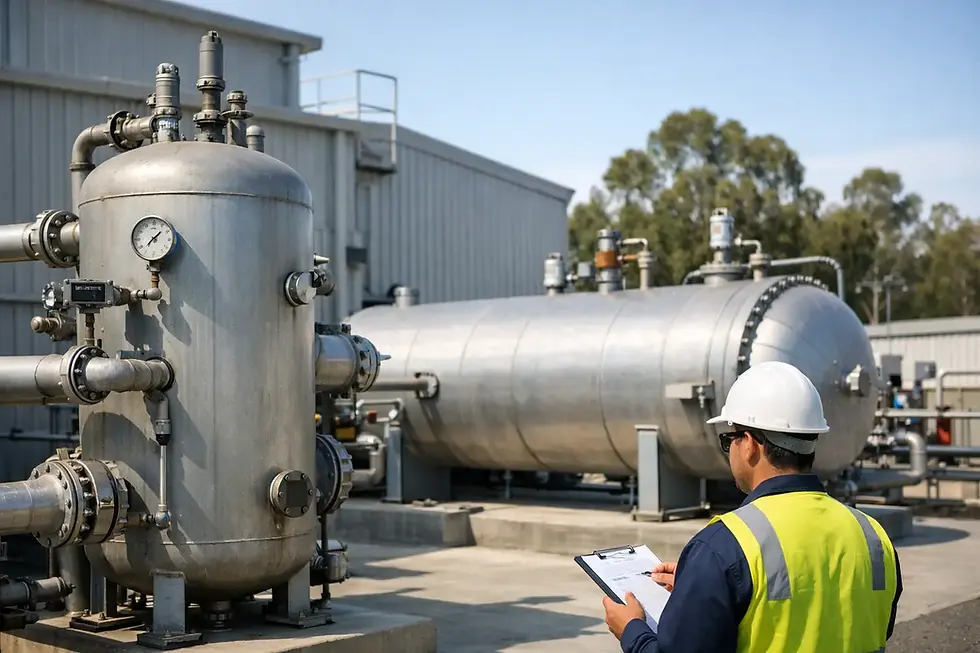
The field inspection then examines accessible pressure parts and associated safety-critical equipment. Depending on the agreed scope, this may include external examination, internal examination, thickness measurement, assessment of mountings and safety valves, review of controls and interlocks, and consideration of operational or maintenance evidence. Safe access, isolation, cooling, cleaning and opening of inspection doors are the asset owner’s essential preparation tasks.
Following the inspection, the inspector evaluates the findings against the equipment’s service duty and relevant requirements. A report records the condition observed, any limitations or recommendations, and the basis for the certification decision. If corrective work is required, the final certification must await satisfactory closure of the relevant items.
The Factors That Most Affect Timing
The greatest variable is usually boiler readiness. A boiler that is isolated, depressurised, cooled, drained, cleaned and opened for inspection enables the inspector to examine the required areas efficiently. If access is restricted or the boiler remains too hot to enter safely, an inspection may need to be deferred.
Documentation quality is equally influential. Inspectors need a defensible history, not simply a statement that maintenance has occurred. Previous inspection reports, repair records, pressure testing records where applicable, safety valve servicing information and water treatment trends help establish whether observed conditions are stable, progressive or potentially safety-critical.
The following issues commonly extend a certification programme:
Repairs or alterations requiring engineering review, defined repair procedures or further verification.
Corrosion, erosion, pitting or thinning that requires additional non-destructive examination or thickness monitoring.
Damaged refractory, insulation or access components that prevent adequate examination of pressure parts.
Unresolved safety valve, control, interlock or combustion-related defects.
Missing equipment data, inspection history or records needed to establish suitable operating limits.
The nature of the boiler also matters. Packaged boilers are often more predictable to inspect than older, modified or custom-built plant. However, even a small boiler can require significant follow-up where its operating history is uncertain or its safety devices have not been maintained to the required standard.
Planned Inspections Reduce the Risk of Delay
Certification should be managed as part of the site maintenance plan, not as a response to an expired document or a production incident. A condition-based and scheduled inspection strategy allows plant owners to align the inspection with shutdowns, identify repairs early and avoid placing unnecessary pressure on operations staff.
Before the inspector arrives, the site should confirm the boiler is available and safe to inspect, arrange competent isolation and access, and collate the relevant records. It is also prudent to identify likely repair resources in advance. If an issue is found, the facility can then move from diagnosis to a controlled corrective action without losing time locating qualified support.
There is a trade-off between minimising downtime and obtaining a complete assessment. Deferring internal access may shorten the immediate outage, but it can leave uncertainty unresolved and increase the likelihood of a longer unplanned stoppage later. The appropriate scope should be based on risk, condition, inspection history and the consequences of failure.
Certification After Repairs or Defects
Where repairs are needed, the time to certification depends on the defect and the repair pathway. Minor corrective work may be completed quickly, followed by a targeted reinspection. More significant repairs to pressure-retaining parts may require engineering assessment, approved procedures, qualified personnel, examination during the repair and final verification.
Asset owners should avoid treating an inspection report as a repair specification unless it expressly provides that function. The independent inspector’s role is to identify condition, assess fitness for continued service and state what must be addressed. Repair design and execution must be suitable for the equipment and verified as required before certification can be finalised.
An independent inspection provider is valuable in this stage because the certification decision remains separate from the commercial interest in repairing or replacing the equipment. This separation supports objective advice on whether the proposed corrective action adequately addresses the identified condition.
What a Defensible Certification Record Should Show
A certification record should enable a facility manager, regulator, insurer or future inspector to understand what equipment was assessed, what was examined, what condition was found and what action is required. It should clearly identify any operating restrictions, next inspection requirements and outstanding recommendations.
For South Australian operators, the required approach must also account for the particular plant, workplace duties and applicable regulatory requirements. AS 3788 provides an established framework for in-service inspection of pressure equipment, but it does not remove the need for competent judgement. Inspection intervals and methods must be appropriate to the equipment’s actual service and condition.
Pressure Vessel Inspections Pty Ltd applies this approach through AICIP-accredited in-service inspection capability, AS 3788-aligned assessment and an ISO 9001:2015 quality system. Recommendations are based on observed condition and compliance requirements, independent of manufacturer, repairer or asset-owner interests.
A Practical Timeframe for Asset Owners
For planning purposes, allow several weeks from initial engagement to final certification, even when the expected inspection itself is brief. This provides time to define the scope, schedule the shutdown, prepare the boiler, review records and deal with normal reporting and close-out activities.
Allow a longer window where the boiler is overdue, records are incomplete, internal examination has not been performed for some time or the site anticipates repairs. Bringing the inspector into the shutdown planning stage gives the business the best opportunity to protect production while maintaining a sound compliance position.
The fastest certification is not the one issued with the least scrutiny. It is the one supported by prepared plant, complete records, safe access and an inspection programme that identifies concerns before they become an unplanned shutdown.
Comments